
New ideas within an untouched historic fabric
UNFINISHED · Bayt El Memar, Old Cairo · 2025 · Completed
UNFINISHED presents the graduation projects of Coventry University students in Egypt within Bayt El Memar, a restored historic Cairene house. The student work explores the adaptive reuse of abandoned industrial heritage, proposing new social, cultural, and environmental roles for neglected structures.
The exhibition brings these speculative futures into a building with its own long material and cultural history. Rather than treating the venue as a neutral container, the design keeps its rooms, proportions, and craftsmanship central to the visitor’s experience.
01 / THE SETTING
A house as a cultural framework
A house as a cultural framework
Bayt El Memar stands in Old Cairo, within an area shaped by Islamic architecture and significant cultural landmarks. Its domestic spaces preserve traces of traditional craftsmanship, spatial hierarchy, and social life. Today, it provides a setting for architectural discourse and the exchange of building knowledge.
This context gives the exhibition a second layer of meaning. Projects concerned with transforming industrial heritage are encountered within another form of inherited architecture. Preservation and reinvention become visible at the scale of both the exhibited work and the venue.

02 / DOCUMENTATION
Understand the existing before intervening
Understand the existing before intervening
The process began with a detailed survey using iPad LiDAR scanning. The scan recorded dimensions, existing furniture, and surface textures, establishing a basis for drawings and spatial analysis.
Documentation informed how the displays could sit within the building. It helped the design respond to existing proportions and circulation, rather than imposing a layout developed independently of the site. The survey became a tool for care and precision.
03 / THE EXHIBITION IDEA
A contemporary insertion with a light touch
A contemporary insertion with a light touch
The central principle is to leave the original walls and architectural elements untouched. Display tables occupy the centres of rooms, maintaining a respectful distance from historic surfaces and keeping views through the building open.
The exhibition is therefore read as a contemporary insertion within a dominant historic framework. Furniture remains visually restrained, allowing models, drawings, and the architecture around them to coexist without obscuring one another.
04 / THE THRESHOLD
Introduce the work, orient the visitor
Introduce the work, orient the visitor
A tilted vertical display at the entrance introduces the exhibition and establishes the first point of orientation. Its reverse face carries conceptual diagrams, giving an overview of shared themes and design strategies across the graduating cohort.
This element works in two directions. It announces the exhibition on arrival, then becomes a collective reference as visitors move beyond it. The entrance is treated as part of the narrative rather than simply a place for signage.
05 / MAKING THE INTERVENTION
Dry assembly, freestanding elements
Dry assembly, freestanding elements
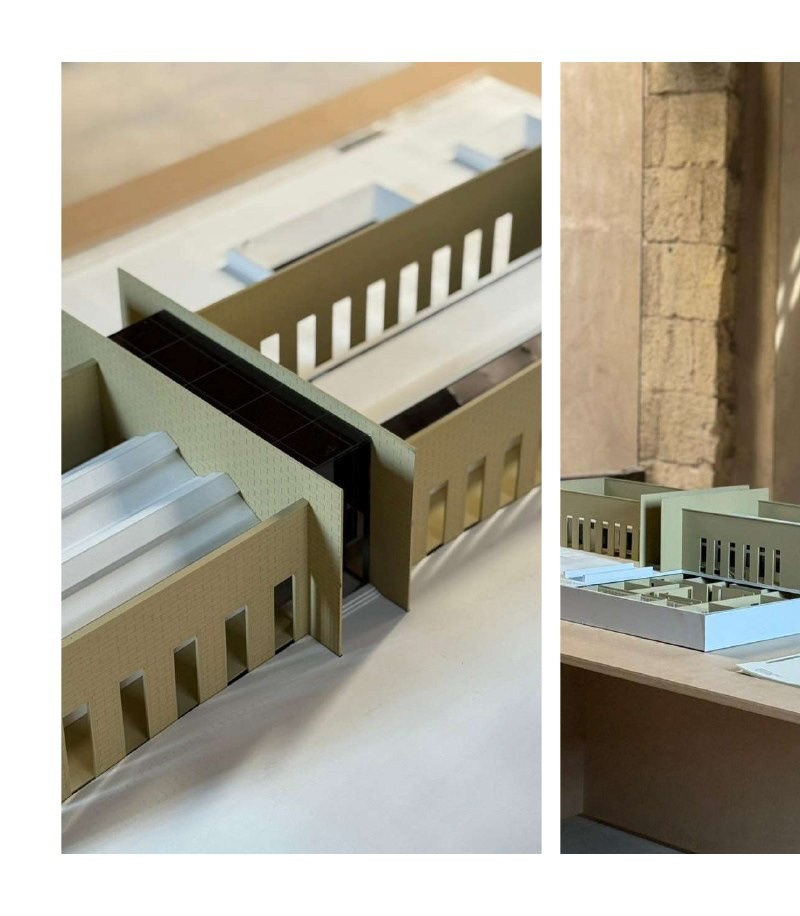
The display furniture uses raw, monochromatic materials and dry assembly. It avoids nails or fixings into the historic building. Layered construction makes the elements compact for transport and allows them to be assembled on site.
Their placement and proportions respond to the building’s lines and spatial rhythm. Avoiding physical damage is only one part of the approach; the displays must also preserve the visual presence of the existing architecture. Clear sightlines and restrained supports help maintain that relationship.
06 / THE EXPERIENCE
Between memory and possibility
Between memory and possibility
The exhibition places architectural propositions for the future alongside the material traces of the past. Its intervention remains reversible and legible, allowing visitors to distinguish the temporary displays from the fabric that receives them.
UNFINISHED is built around this dialogue: how to introduce a new use without erasing what already gives a place its identity. That question is explored by the student projects and repeated in the exhibition design itself.
PROJECT RECORD
Project: UNFINISHED Exhibition
Venue: Bayt El Memar, Old Cairo, Egypt
Project year: 2025
Status: Completed
Client: Egyptian Ministry of Culture
Team: Dr. Mohamed Raafat, Mamdouh Hani, Yaza Safwat
Supervision: Prof. Moataz Samir, Prof. Cristiana Penna
Exhibited work: Coventry University student graduation projects
